
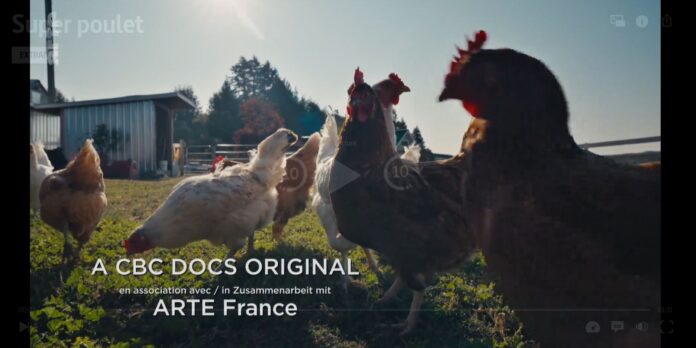
The Franco-German public broadcaster aired on 4 May a piece that turns the public perception of poultry on its head. The documentary gives a platform to a scientific movement that has spent years working on something that until recently sounded like science fiction: translating what domestic birds say to one another. Leading this effort are academic groups such as that of Professor Suresh Neethirajan at Dalhousie University, and European companies such as the Spanish firm CEALVET, with its patented VocalData® ecosystem.
On Monday 4 May 2026 at 16:35, the European public broadcaster ARTE premiered, free-to-air and at no charge, «Super Hens» (Super Poulet, in the original version), a Canadian documentary directed by Jeff Morales that takes viewers to the family farm at Hillpoint on Vancouver Island to demonstrate something most of the general public does not know: that hens and chickens are not nearly as “bird-brained” as has long been assumed.
The film, running approximately one hour and available on the ARTE.tv platform from the day of its premiere and free to view until 3 July 2026, surveys the extensive cognitive and sensory repertoire of the domestic fowl (“gallus gallus”). The documentary recalls that these birds — distant relatives of the dinosaurs, domesticated some 3,600 years ago in what is today Southeast Asia — are capable of recognising themselves in a mirror, identifying colours, letters and numbers, interpreting signals, learning patterns, and navigating complex social hierarchies. This is the very opposite of the popular image that reduces them to uniform units of production.
From the myth of the ‘stupid hen’ to the science of avian communication
The documentary’s interest, however, does not stop at popular science. Super Hens brings to a general audience a conversation that has been taking shape for years in the scientific literature and among poultry technology companies: bird vocalisations are not random noise, but coded signals carrying semantic value.
Among the experts interviewed is Professor Suresh Neethirajan, University Research Chair in Digital Livestock Farming at Dalhousie University (Canada), whose team has been applying natural language processing models — the same ones underlying systems such as OpenAI’s Whisper — to decode the vocalisations of hens from more than thirty poultry farms across North America and Europe, including flocks affected by avian influenza and a range of health conditions.
In a recent LinkedIn post published to mark the premiere, Neethirajan himself summarised the conceptual shift the documentary puts forward: birds are “cognitively capable, socially structured, and highly perceptive” animals, yet most production systems continue to treat them as uniform units. His work, he noted, involves decoding vocal communication and behavioural patterns to infer latent welfare states using AI and multimodal sensors. One sentence from his post neatly encapsulates the underlying thesis: «precision livestock farming cannot advance if we ignore the intelligence of the animal itself».
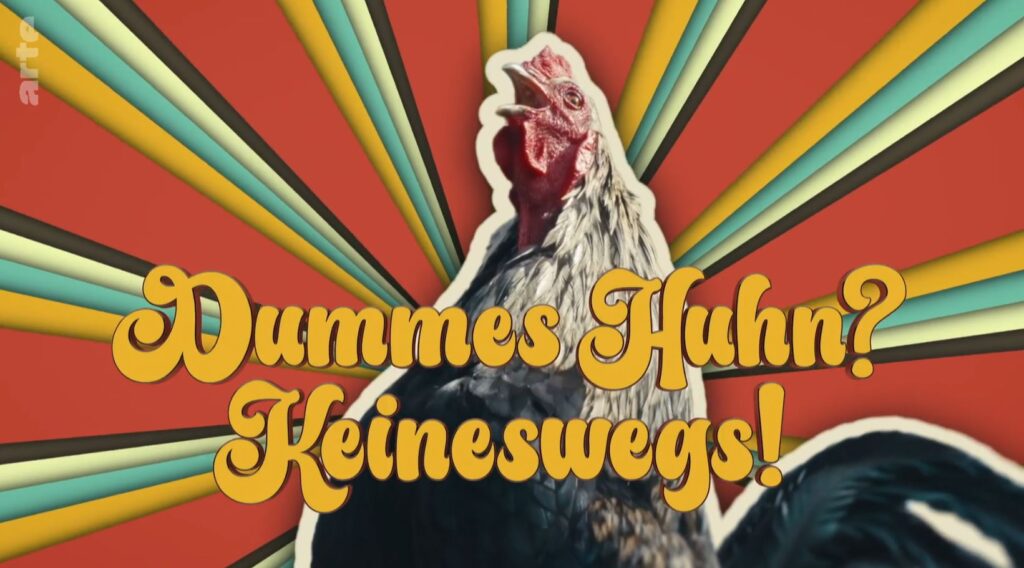
Productive hybridisation and health vulnerability
The documentary takes a detour to a farm in Normandy, France, dedicated to saving the ancient Crèvecoeur breed from extinction, using it to introduce a second major finding that should give the industry pause for thought: between 90% and 95% of the world’s poultry today belong to hybrid breeds, selected to maximise egg or meat yields, but whose reduced genetic diversity may make them more vulnerable to viruses. This is a timely reminder at a moment when the pressure of highly pathogenic avian influenza continues to set the global poultry biosecurity agenda.
Avian bioacoustics moves out of the laboratory
What the general public will discover through ARTE, the specialist poultry sector has been observing closely for some time. Bioacoustics applied to poultry production has moved beyond an academic niche to become a field with granted patents, R&D projects funded by European programmes, and commercial technology deployed in hatcheries and farms.
In Europe, one of the leading players in this field is the Spanish SME CEALVET, based in Tortosa (Tarragona) with an AI lab in Barcelona, a pioneer in the development of a patented avian bioacoustic monitoring ecosystem under the brand VocalData®, whose European patent (EP4412448) covers a «method and system for assessing livestock welfare based on the analysis of vocalisation acoustic signals». Its approach, aligned with what the documentary puts forward, integrates analysis of the sounds emitted by a flock with environmental parameters — temperature, humidity, CO₂, and light intensity and colour — to transform vocalisations into actionable alerts for farm teams. The company also participates in the Eurostars European project BAEHealth (Bioacoustics Automatic Evaluation system for poultry Health), which is working specifically on the automated assessment of bird health from acoustic signals.
The approach fits squarely within the conceptual framework the documentary places on the table: moving away from treating each bird as an interchangeable unit and beginning to listen to what each flock is communicating in real time.
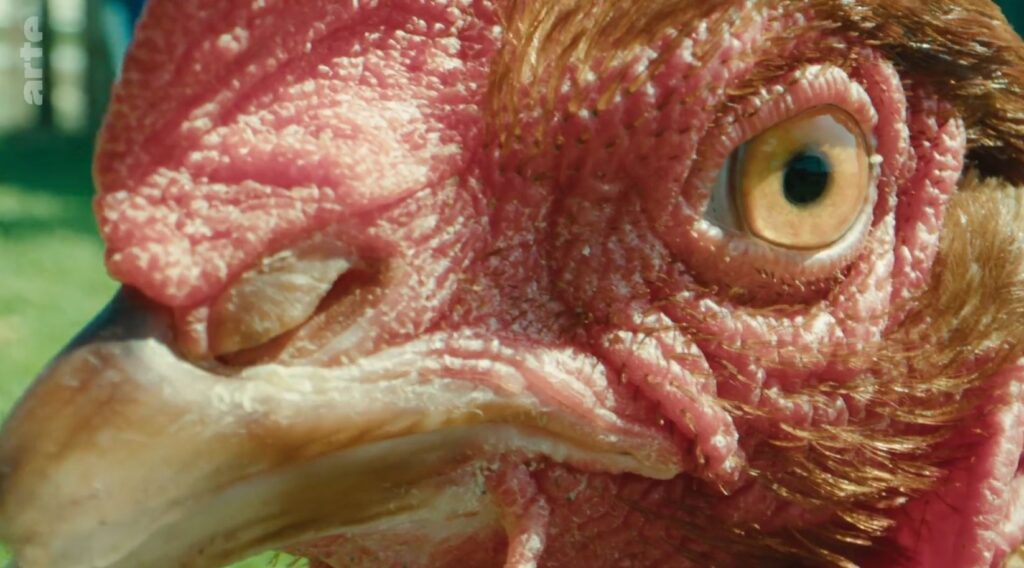
A documentary on a globally broadcast channel that addresses the “gallus gallus” and the major advances the industry is making in interpreting our chickens and hens is very welcome and positive news.
Super Hens arrives at a moment when the public conversation about artificial intelligence is dominated by chatbots, conversational assistants, and promises of industrial robotisation. The documentary, without explicitly setting out to do so, offers the poultry sector a useful reminder: the real transformation of poultry production will not come from putting a ChatGPT in the farm office or replacing the poultry farmer with a humanoid robot. It will come from something more subtle and, paradoxically, more ancient: returning attention to the animal.
With one substantial difference from the past. Today, thanks to low-cost sensors, high-sensitivity microphones, 4G connectivity, and artificial intelligence models trained on thousands of hours of on-farm recordings, that listening can be continuous, non-invasive, quantitative, and industrial in scale. That is the paradigm shift shared, through complementary approaches, by Professor Neethirajan at Dalhousie and European teams such as CEALVET: knowing how to “read” the biology, knowing how to “listen to and interpret” the universal language of production birds — not merely monitor them.
Chickens and hens, whom the ARTE documentary champions as the «unsuspected superstar of evolution», have been speaking to us for 3,600 years. The novelty is not that they are now speaking more. The novelty is that, for the first time, we are beginning to have the tools — and the humility — to listen.
Federico Castelló
Documentary details
Super Hens (Super Poulet) · Director: Jeff Morales · Canada, 2026 · Broadcast on ARTE: Monday 4 May, 16:35 · Also available on ARTE.tv from 4 May 2026 and free to view until 3 July 2026 · Watch on ARTE.tv